The Downtown That Reinvented Itself
If you're exploring Downtown LA real estate, you're looking at the most dramatically transformed neighborhood in Los Angeles. There's a particular hour in Downtown Los Angeles — early evening, when the light goes amber against the glass towers and the sidewalks fill. Twenty years ago, that hour didn't exist. Downtown emptied at five. The lights went out. The streets belonged to no one.
That a neighborhood could change this completely, this fast, is the whole story of living in Downtown Los Angeles today — and it's why DTLA condos and lofts have become some of the most distinctive homes in the city. Here's what to know before you buy.
How Downtown LA transformed: the 20-year story
The quiet ordinance that started everything
In 1999, the city passed the Adaptive Reuse Ordinance. It sounds like paperwork, but it was a revolution. For the first time, the grand old bank buildings and vacant office towers of Downtown — many empty since mid-century — could be converted into homes. The result: more than 12,000 new residences, most in the first decade. A district that was "almost strictly business" became one of the most sought-after urban neighborhoods in Los Angeles. In December 2025, the city expanded that ordinance citywide.
Two decades that redrew the skyline
2003 — Walt Disney Concert Hall. Frank Gehry's silver sails on Bunker Hill.
2012 — Grand Park. Twelve green acres connecting City Hall to the Music Center.
2015 — The Broad. A free contemporary art museum beside Disney Hall.
2017 — Wilshire Grand Center. At 1,099 feet, the tallest building west of the Mississippi.
2022 — The Grand LA. Gehry again, answering his own Concert Hall across the street.
DTLA condos for sale & loft living
Downtown is where DTLA lofts and modern high-rise condos define the market. Two broad styles dominate: historic adaptive-reuse lofts (soaring ceilings, exposed brick and timber, oversized windows in converted 1900s–1920s buildings) and new-construction condos (full-service towers with concierge, rooftop pools, and skyline views around South Park, Bunker Hill, and the Financial District).
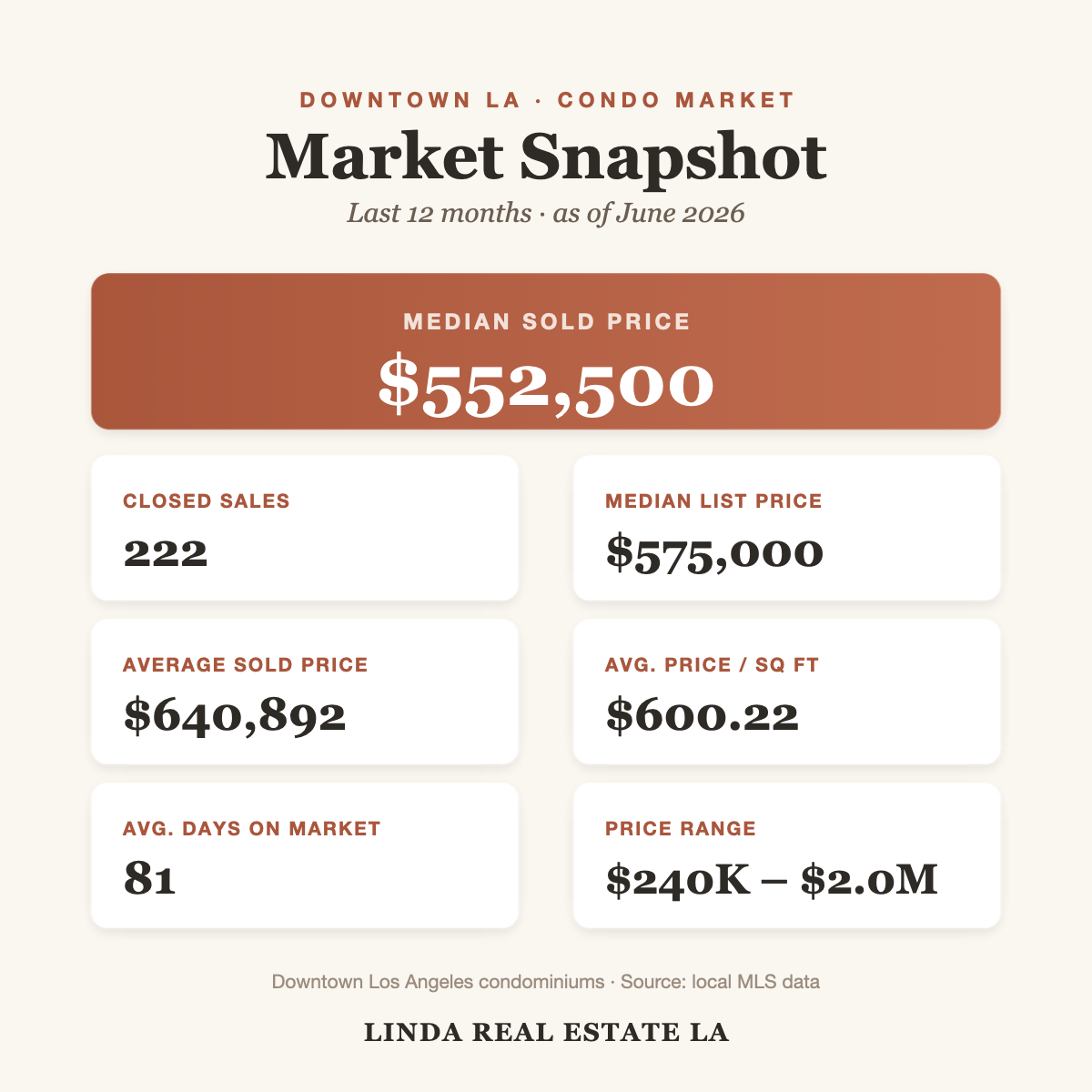
(Figures from local MLS data, trailing 12 months. Reach out for a current, address-specific analysis.)
Walkability & lifestyle: living in Downtown Los Angeles
Downtown is among the most walkable neighborhoods in LA — Walk Score around 95 out of 100 — with the Metro rail hub at 7th/Metro connecting you across the county without a car. Groceries at Grand Central Market, gallery openings in the Arts District, a concert at Disney Hall, a game at the arena — all within blocks.
And the beach is closer than you'd think. Since 2016 — when the Metro E Line (formerly the Expo Line) was extended all the way to the coast — you can ride straight from Downtown to the Santa Monica Pier in about 46 minutes. No car, no traffic, sand to skyline. It's one of the quiet perks of Downtown living that surprises buyers most.
And my favorite day of the year? CicLAvia. Several times a year — and most memorably each fall, when the "Heart of LA" route runs straight through Downtown — the city closes its streets to cars entirely and hands them over to cyclists, skaters, and walkers. For one day, Downtown becomes a giant car-free, open-air city, and there's truly nothing else like it. (Routes and dates at ciclavia.org.)
The spots you can only find in DTLA
Grand Central Market (since 1917) — 37 vendors under one roof, Salvadoran to Japanese.
Angels Flight (since 1901) — "the shortest railway in the world," its orange cars Olivet and Sinai still climbing Bunker Hill.
The Bradbury Building (1893) — wrought iron and golden light you've seen in Blade Runner.
The Central Library (1926) — Bertram Goodhue's Art Deco landmark, crowned by a mosaic-tiled pyramid and the "Light of Learning" torch. One of the most beautiful libraries in the country and a downtown treasure alongside the Bradbury Building and Union Station.
The Last Bookstore — rare books shelved in the vaults of a 1914 bank, with an archway built of books.
The Arts District — 1970s artists claimed the empty warehouses east of Alameda and never left. Today: murals, galleries like Hauser & Wirth in a restored flour mill, Bestia (since 2012), and Row DTLA in the old produce terminal.
Is Downtown LA right for you?
You're not buying into a finished neighborhood. You're buying into one with twenty years of forward momentum — where a vacant tower can become a home, a flour mill can become a gallery, and a five-minute walk crosses a century of architecture. The square-foot math surprises people coming from the Westside. The lifestyle surprises them more.
Frequently asked questions about Downtown LA real estate
Is Downtown LA a good place to live?
For buyers who want a walkable, car-optional, culturally rich urban lifestyle, yes. DTLA offers historic lofts and full-service condo towers steps from world-class dining, museums, and the Metro hub.How much do condos cost in Downtown LA?
Over the trailing 12 months (as of June 2026), the median sold condo price in Downtown LA was about $552,500, with sales ranging from $240,000 to $2,000,000 and averaging roughly $600 per square foot. Reach out for a current, address-specific analysis.What is Downtown LA known for?
Its skyline (including the Wilshire Grand), landmark architecture (Disney Concert Hall, The Broad, the Bradbury Building, the Central Library), Grand Central Market, the Arts District, and a 20-year residential renaissance.Are there lofts for sale in Downtown LA?
Yes — DTLA has one of the largest concentrations of authentic adaptive-reuse lofts in the country. Contact us to be notified of new listings first.Thinking about a move to Downtown LA?
I have a Downtown loft listing arriving soon that captures exactly this. As a Los Angeles real estate agent, I'd love to help you find the right DTLA home.
