Rank Your Dealbreakers Before You Fall In Love
I'll tell you something most agents won't say out loud: when you're buying a home in Los Angeles, you will almost never find one that checks all your boxes.
Is it possible? Yes — but the LA market runs hot, and the homes that come closest are exactly the ones every other buyer wants too. When you're competing for the hottest listings, you have far less room to hold out for every last item on your list. Honestly, the only sure way to check every box is to start from scratch — buy a teardown and build new, where you decide on the construction down to the detail. Short of that, the "perfect" home is usually a wish list assembled from ten different houses you've seen online. Walk-in closet from one. Backyard from another. Open kitchen from a third. Stack them up and you've described a unicorn.
In my experience, the buyers who struggle most are the ones who never set a dealbreaker list before they started searching. Really, it comes down to two paths: build a home from scratch that checks every box, or buy a home that checks some of them and has the potential to be updated to your liking once it's yours. That's why I've found buyers do best when they define their list ahead of time — it narrows the search and makes everything that follows easier. When we can, I like to sit down with my buyers and map this out before the search even begins.
So in every buyer consultation, before we tour a single home, I walk my clients through a five-minute exercise. It sounds like simple mental gymnastics. It saves months of second-guessing — especially in a fast-moving market like LA.
The house-hunting exercise: rank your dealbreakers
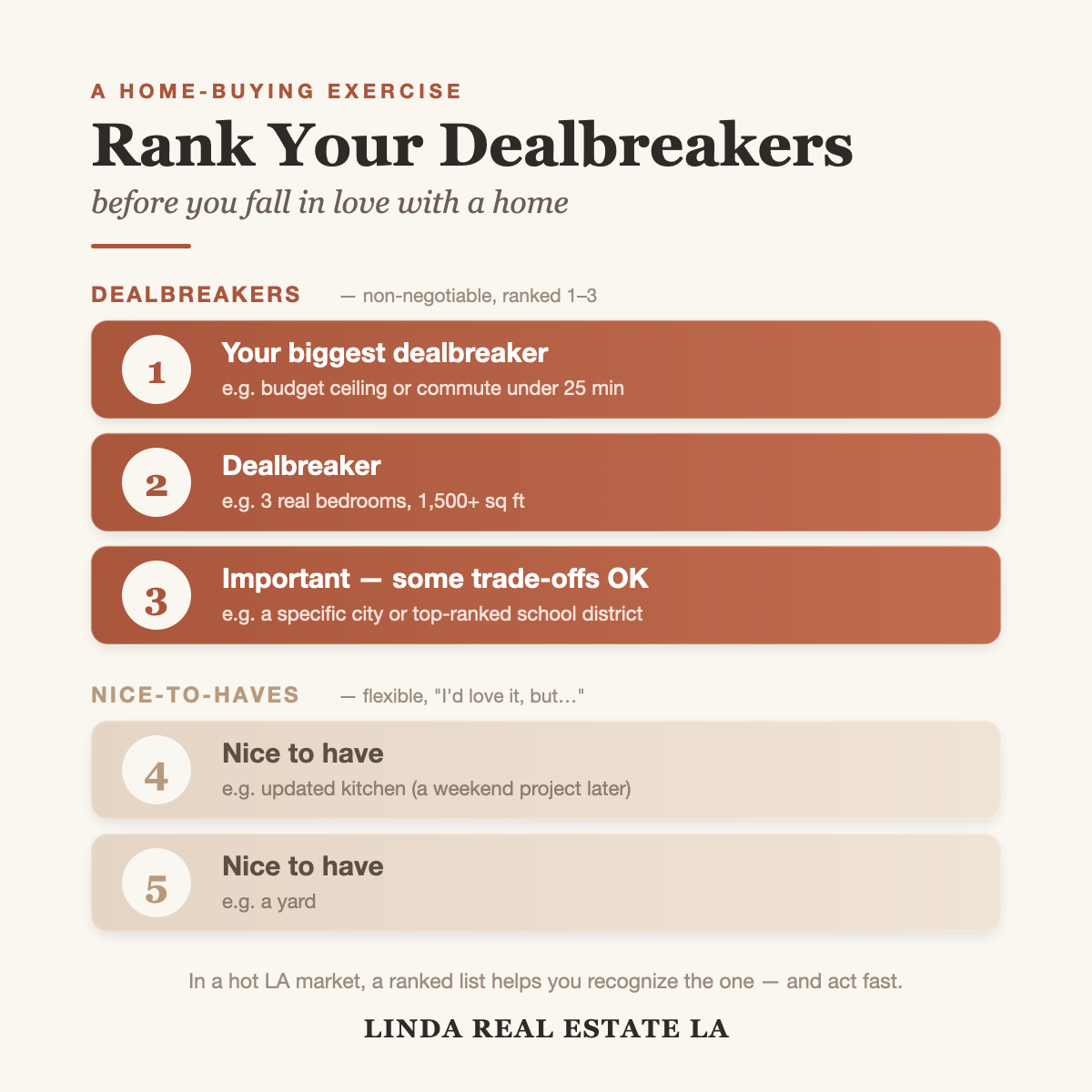
Step 1 — List your top 3 must-haves, in order. Not five. Not ten. Three. These are your true non-negotiables — things like a home no smaller than 1,500 square feet, a specific city or neighborhood, or a top-ranked school district. Number one is your biggest dealbreaker, the thing you'd walk away from any home for. Number three is still important, but you'd consider trade-offs.
Step 2 — Then continue the list to 5. Items four and five are the "I'd love it, but…" wishes. Ideally, write them down — but keep them in a different tier than your top three.
That's it. Five items, ranked from hardest dealbreaker to softest.
Why ranking your must-haves vs. nice-to-haves changes everything
The magic isn't the list. It's the order. When everything is a "must-have," every home fails — because no home is perfect, and an unranked list has no give in it.
And in Los Angeles, that rigidity costs you the most. The desirable areas have almost no land left to build on, so inventory stays tight and the best homes draw multiple offers within days. When you're competing against other buyers for a scarce home, a list with no flexibility means you hesitate over small things and lose it — or chase one home's single strength while ignoring another's real dealbreaker.
But when your priorities are ranked, three things happen:
You recognize the right home faster. When a home nails your top three, you know to move. In LA, the right home doesn't wait.
You negotiate from clarity, not emotion. A flaw in your number-five slot is a paint color. A flaw in your number-one slot is a reason to keep looking.
You stop second-guessing. A ranked list is something to point back to: this checks one, two, and three. We're good.
A quick example
Say your ranked list is: (1) Under a 25-minute commute — dealbreaker; (2) Three real bedrooms — dealbreaker; (3) Natural light — strong preference; (4) Updated kitchen — nice to have; (5) A yard — nice to have. Now a home appears: great light, three bedrooms, twenty-minute commute — but a dated kitchen and a small patio. An unranked buyer hesitates over the kitchen and yard. A ranked buyer sees it instantly: it hits one, two, and three. The kitchen is a weekend project. This is the one.
Same house. Completely different decision — because the priorities were ordered before the emotions arrived. And there's a bonus hiding in that trade-off: buying a home with a dated kitchen or bathroom and updating it later isn't really a compromise — it's an opportunity. Those improvements, made on your own terms, build real equity in the home you now own.
The point isn't to settle. It's to choose.
Ranking your dealbreakers doesn't mean lowering your standards. It means knowing them well enough to act with confidence when the right home shows up — and to walk away, calmly, when it doesn't.
Frequently asked questions
-
List your top three must-haves in order of importance, then add two "nice-to-haves." Ranking them from biggest dealbreaker to smallest preference makes homes easier to evaluate.
-
A must-have is something you'd walk away from a home over — commute, bedrooms, budget. A nice-to-have is a feature you'd love but could add later — an updated kitchen, a bigger yard.
-
There's no magic number, but here's what works: I like to schedule a full day of showings, arranged from your top picks down to your least favorite. Seeing them back-to-back trains your eye quickly — most buyers start to get a real feel for an area after about 7 to 10 homes. By then you've seen enough to recognize an opportunity the moment it comes your way, instead of comparing every house to an impossible ideal. Buyers who rank their priorities first tend to get there even faster.
-
A local LA buyer agent helps you define priorities, spot dealbreakers early, and compete in a fast market.
Let's build your list
If you're starting to think about buying a home in Los Angeles, this is the first thing we'll do together. We'll spend five minutes ranking what actually matters — before you fall in love.
