Why the First Week on Market Matters — For Every Home, Every Price Point
There is a window in every listing — brief, concentrated, and impossible to recreate once it closes. It doesn't matter if the home is priced at $600,000 or $6,000,000. The psychology is the same.
In my experience, this window opens the moment a home goes live on the market. It brings together the algorithm-driven feeds of Zillow, Redfin, Realtor.com and all their linked sites, the curated broker networks built on years of trust, and the attention of buyers who have been quietly watching and waiting for the right property to appear. It lasts about seven days.
What happens inside that window shapes the entire trajectory of a sale. In some cases it compresses the timeline dramatically. In others, when the window is missed or wasted, a property drifts — accumulating days on market and questions it shouldn't have to answer.
Throughout my career, this is something I've noticed that not enough people talk about — and time and again, it has helped my clients sell successfully. The first week isn't a hope. It's a strategy. And understanding it is one of the most practical things a seller can do.
The Psychology of Newness — and Why It Has a Shelf Life
With the amount of data available online, most buyers today are sophisticated. They don't rely on their agent to find homes — they can easily find them on their own. Many are watching listings for months before they act. They know the neighborhoods they want, they have a sense of value, and the moment something new appears in their saved search, they notice. They also know exactly how long a property has been on the market, whether it's come back after falling out of escrow, and what the surrounding market looks like. Buyers arrive informed — and they notice everything.
That newness is a form of social signal. A fresh listing communicates that an opportunity exists right now — and buyers respond to that with a kind of attention that a property sitting at 60 days on market simply cannot command.
There's also an emotional dimension to it. A new listing creates curiosity. It invites projection. Buyers imagine themselves in the space before they've even walked through it, because the idea of the home is still open and uncontested. Once a property has been on the market for several weeks — especially if the price has shifted — that imagination dims. The questions begin. Why is it still available? What did I miss?
These are the questions that a strong first week prevents entirely.
The Algorithm Tends to Be More Aggressive in Week One
From what I've consistently observed, real estate platforms push new listings harder in the opening days than at any other point in the listing's life.
When a property is listed on the MLS, it syndicates automatically to Zillow, Redfin, Realtor.com, and dozens of partner sites — all at once.
In that first week, the listing tends to surface more prominently in search results, may be flagged as "New," and triggers alerts for every buyer who has set up a saved search matching that neighborhood, price range, or property type. In that environment, presentation matters. The way a property is introduced online can dramatically influence whether buyers choose to schedule a showing.
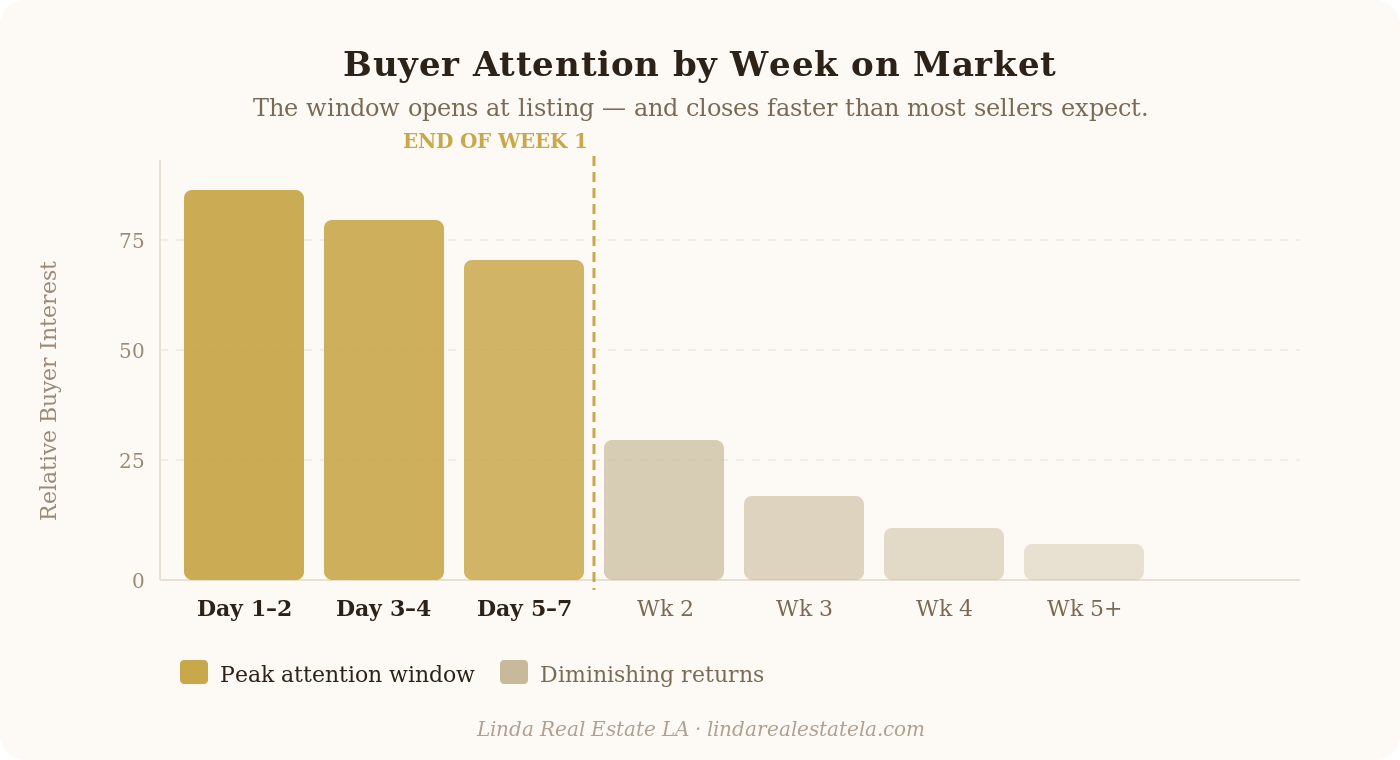
That momentum is real — but it fades quickly. It does not persist through a price reduction. It does not reset after a few weeks. Once it's gone, the property becomes part of the background noise of inventory rather than a new opportunity worth acting on.
This is why timing, preparation, and a coordinated launch matter. The platform is working for you in week one. The question is whether you're ready to make the most of it.
What Happens Before the Listing Goes Live
Weeks before a home goes live, I stay constantly in tune with the market and in close communication with my sellers — because giving them the best chance to sell quickly, at the highest price, and as smoothly as possible starts long before the listing is active.
Sitting with my clients and educating them about the process is almost as important as the launch itself. We coordinate the photoshoot, discuss the role of staging, talk through decluttering, address the question of whether to move out or stay in during showings, and — critically — we work through pricing strategy together. Every one of these decisions shapes what the first week looks like.
A seller who arrives at launch day prepared and informed is a seller whose home hits the market with momentum. A seller who is still making these decisions after going live has already lost time they can't get back.
Back to the Basics of Economics: The Law of Supply and Demand
At the core of every real estate transaction is a simple economic principle: supply and demand. Your home is a single unit of supply. The goal of a launch strategy is to put as many qualified buyers as possible in front of that supply — simultaneously — in the window when attention and energy are highest.

When multiple buyers are looking at the same property at the same time, competition builds. Urgency increases. Offers come in faster, and stronger. The seller's negotiating position improves. This is not a tactic — it is economics.
Several factors influence whether a home receives offers at or above list price:
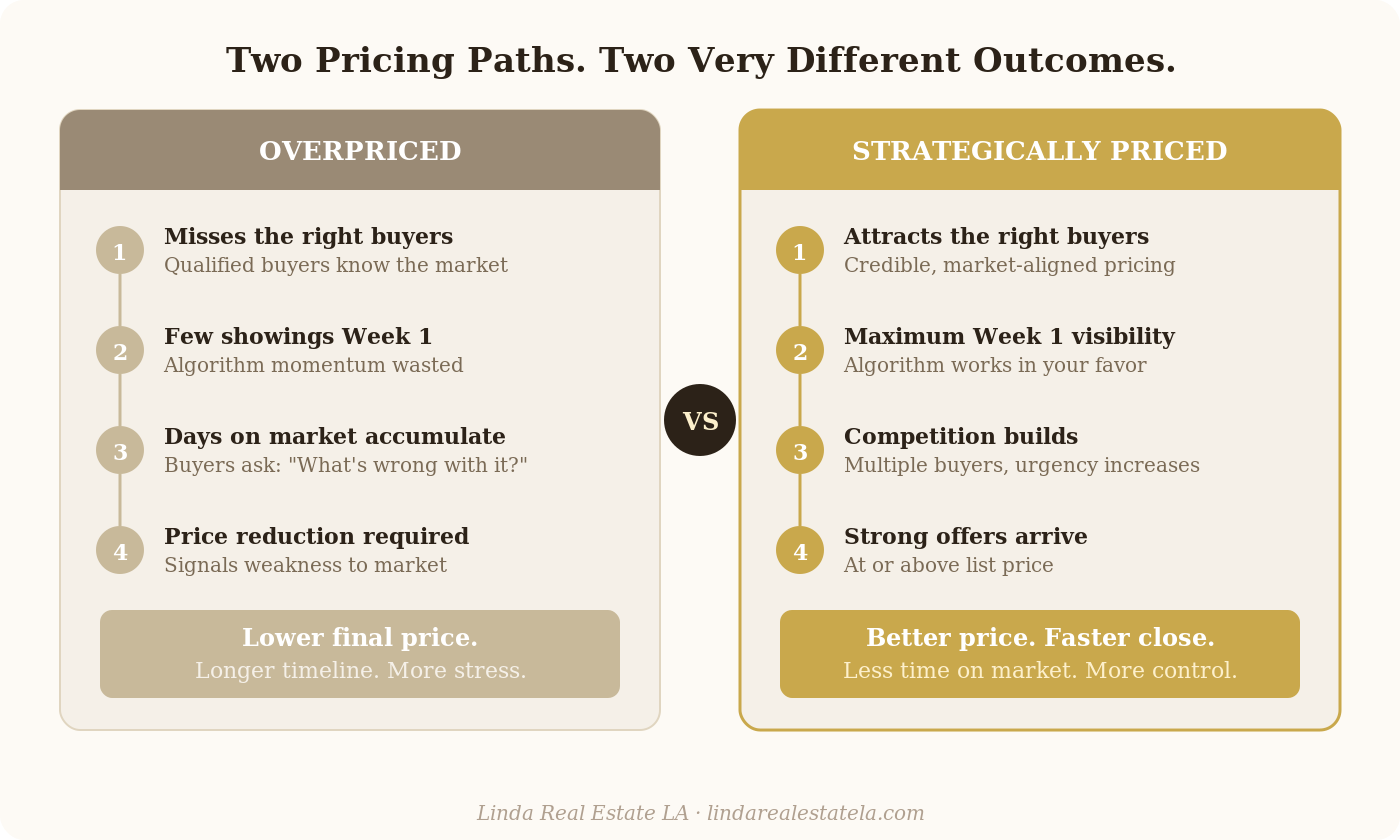
Strategic Pricing — A home priced in line with market reality attracts the right buyers immediately. Overpriced homes repel the most qualified buyers in week one — the very buyers who have been watching the market long enough to know the difference.
Presentation — Photography, video, and staging are not cosmetic. They are the listing. In a market where buyers form first impressions online, the quality of visual presentation determines whether a showing happens at all.
Availability — The easier a home is to show, the more buyers see it. Restricted showing windows reduce the number of qualified eyes on the property during the critical first week.
Past Sales — Comparable sales in the area give buyers and their agents a benchmark. A home priced and presented in alignment with recent comps signals credibility and invites confident offers.
Visibility — Open houses, a coordinated online launch, and social media distribution all expand the reach of a listing in that first week. The more channels, the more potential buyers reached simultaneously.
One factor, however, remains unknown until the offers arrive: demand.
Who is actively looking for a home like yours right now? How many of them are there? How much are they willing to pay? These questions cannot be fully answered in advance. The market reveals them. And the more eyes on the property during launch week, the greater the chance of uncovering that demand — and letting it work in your favor.
Overpriced homes lose first-week momentum and reduce the number of eyes on the property at exactly the moment when visibility matters most. The irony is that overpricing in an attempt to leave room for negotiation often produces the opposite result: fewer buyers, less competition, and ultimately a lower final price.
Ultimately the Seller Doesn't Determine the Price — The Demand Does
This is one of the most important things I share with my clients before we go to market, and it's worth saying directly:
The seller doesn't determine the price. The agent doesn't determine the price. What ultimately decides the price is the demand — the buyers who are out there at that specific moment in time, looking for a home like yours, and what they are willing to pay for it.
What the seller and agent can control is everything that influences how much of that demand shows up in week one. Pricing it right. Presenting it beautifully. Making it easy to see. Launching it with as much visibility as possible. Creating the conditions for competition.
The market does the rest.
The Buyer You Can't Predict — and Why That Matters
Here is one of the most honest things I can say about real estate: we never fully know who is actively searching for a specific property at any given moment.
The buyer for your home may be someone your agent has never met. They may be relocating from out of state. They may have set a saved search alert months ago and be waiting for something exactly like your home to appear. They may be a neighbor who has always admired your house from the street.
This is both humbling and useful. It reinforces why broad early visibility matters. The more channels through which your home is introduced during that first week, the greater the chance of reaching the buyer you didn't know was looking.
A Glimpse at My Process
For every launch, my sellers and I work through a preparation process together — because the best first weeks are built well before the listing goes live. I guide each client through every step so nothing is left to chance. Some of what that looks like:
Before launch:
Professional photography, video, and staging completed before go-live
Listing description written with lifestyle detail — not specs alone, but the feeling of the home
Full list of upgrades documented and ready to share from day one
Video walk-through ready to upload at launch
Social media visuals and assets prepared for distribution on launch day
First open house scheduled for the debut weekend
Neighbor invitations sent — neighbors often know someone who has been waiting for exactly this kind of home
During week one, I track:
Total listing views across all major platforms.
Showing requests in the first 72 hours, and again at day seven.
Agent inquiries following the broker preview.
Open house attendance and the quality of conversations.
Aggressive follow-up on every single signal of interest.
But this isn't all of it.
If you want to know the full recipe — the specific steps, the timing, and the details that I believe have contributed to so many 5-star reviews from my clients — reach out. I'm happy to walk you through it personally.
Case Study: 11630 Chanera Ave, Hawthorne
11630 Chanera Ave in the Holly Park neighborhood of Hawthorne is a straightforward illustration of what first-week momentum looks like in practice.
The property — a sun-drenched 3-bedroom, 2-bathroom mid-century gem, 1,192 square feet on a 5,101 square foot lot — was listed at $770,000. It had been thoughtfully prepared before launch: a 2024 interior repaint, updated kitchen cabinets, remodeled bathrooms, and professional photography that captured the warmth and character of the home. The listing copy led with lifestyle — the original wood floors, the cozy fireplace, the mature fruit trees in the backyard, the easy proximity to Manhattan Beach, El Segundo, SoFi Stadium, and the Westside tech corridor.
The result: the home went into escrow in 7 days with multiple offers.
That outcome didn't happen by accident. It happened because the preparation was done, the pricing was strategic, and the home was introduced to the market in a way that created genuine competition in week one.
*A note on niche properties: the principles above apply to the broad market. Some homes — highly specific in design, location, or use — attract a narrower pool of buyers by nature. For those properties, the timeline may be longer regardless of strategy, simply because the right buyer is rarer. That is not a failure of the first week — it is the reality of a particular kind of home finding a particular kind of buyer.
Final Thought
The first week on market is not a marketing opportunity to maximize for its own sake. It is the moment when your home is most visible, most compelling, and most likely to attract the attention of buyers who are genuinely ready to move.
A thoughtful strategy, entered into with care and preparation, gives your home the best chance to find its buyer — not eventually, but right at the beginning, when everything is in your favor.
If you're thinking about a sale in the next six to twelve months, I'd encourage you to start the conversation early. The preparation that makes a first week successful begins well before listing day.